Understanding the Sacrament of Matrimony: A Guide for Catholic Couples
I’m starting this guide with a discussion of the Sacrament of Matrimony because it’s fundamental that you understand the Catholic Church’s views on marriage and are fully aware of why you’re choosing to get married in the Church. You must willingly choose to receive this Sacrament. If you already have a deep understanding of the Sacrament of Matrimony, feel free to skip this chapter.
Why Do You Want to Get Married in the Catholic Church?
This question is a foundational place to start. If your parish priest asked you this question, what would your response be? You might say: • “Because I love God” • “I always wanted to get married in the Church” • “I want God to bless my marriage” • “Because my parents want me to” If these reflections are your current state of mind, your parish priest will likely ask you additional questions to get to the heart of your decision to take sacramental wedding vows.
Your Priest Isn’t Judging You
When your priest asks you these questions, he’s not judging you or your future spouse. Rather, he’s trying to help you understand why you’re making this very important decision. The Church views matrimony as a lifelong commitment made before God, one you must freely enter into, so your preparation for this sacrament is very important.
Reflecting on Your Readiness for Catholic Marriage
The following are some questions you should reflect upon as you journey towards Catholic marriage: 1. Do I regularly call upon God and Jesus? 2. Is prayer a part of my daily life? 3. Do I seek to understand God’s Word by studying the Bible? 4. What is my understanding of the Sacraments and how they are meant to be part of my life? 5. Am I an active part of my local faith community? 6. Do I regularly receive the Sacrament of Reconciliation? These are just some of the questions you may ask, and remember, there are no perfect answers.
What the Church Expects
The Church will assume that you actively place your faith in the Lord, looking to Him for guidance through daily prayer and reflection, and that you’re an active member of your parish’s worship community. This type of reflection and spiritual preparation takes time, which is why the Church requires couples to be engaged for a period of at least 6 months.
Why Six Months?
This extended engagement provides you and your future spouse time to: • Participate in a marriage preparation program (as we’ll discuss in the next chapter) • Deepen your understanding of the Sacrament of Matrimony • Grow in your faith individually and as a couple • Prayerfully prepare your wedding liturgy together (which we’ll explore in Chapter 11)
What is the Sacrament of Marriage?
The Sacrament of Marriage is a holy covenant made between a man and a woman, or rather, a sacred, lifelong commitment made between a man and a woman before God.
More Than Just “I Do”
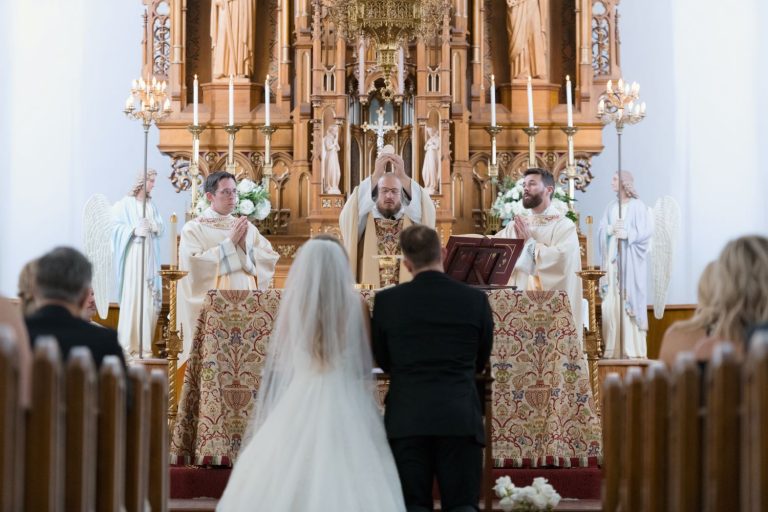
A Catholic wedding isn’t just a promise you make to your spouse by saying “I do” in front of family and friends. It’s a special moment when God bestows upon you the grace needed to live out your marriage vows. The Church expects husbands and wives to give themselves to each other in a permanent and faithful relationship, mirroring the covenant God made with his people in the Bible.
You’re Forming a Team
That’s a fancy way of saying that in a Catholic wedding, you’re not just committing to love and cherish each other for life. You’re also inviting God to be part of your relationship, to guide you through all the ups and downs, forming a team: husband, wife, and God, grounded in love, trust, and faith.
The Biblical Foundations of Marriage: Discovering Divine Love
The Old Testament Roots of Marriage
Marriage is discussed early on in the Bible, right in the very first chapters. In Genesis, God says, “It is not good for man to be alone,” and He creates Eve as a partner for Adam (Genesis 2:18). This is the very foundation of marriage: two people coming together to become one. One of the most beautiful passages is from Genesis 2:24, which says, “Therefore a man leaves his father and mother and clings to his wife, and they become one flesh.” This idea of unity is powerful, and quite honestly, very romantic! God is setting the stage for something extraordinary.
Creating a Deep Bond
This isn’t just about physical togetherness. It’s about creating a deep, emotional and spiritual bond between you and your future spouse as you reflect on what it means to leave your families and create a new one together. It’s a journey that will, no doubt, be both exciting and intimidating, but knowing that it’s rooted in God’s design will give you the sense of purpose and the strength you need to continue when you face difficulties and challenges. With the grace of God to support you, you can not only overcome problems in your marriage but grow stronger as an individual too.
New Testament Teachings on Marriage
But the Bible’s focus on marriage doesn’t stop with the Old Testament. Fast forward to the New Testament, and you’ll find one of the most beautiful descriptions of marriage in St. Paul’s letter to the Ephesians (Ephesians 5:22-33) where he reflects upon the love between a husband and wife as symbolic of Christ’s love for His Church: Wives, be subject to your own husbands, as to the Lord. For the husband is the head of the wife, as Christ also is the head of the assembly, being himself the savior of the body. But as the assembly is subject to Christ, so let the wives also be to their own husbands in everything.Husbands, love your wives, even as Christ also loved the assembly and gave himself up for her, that he might sanctify her, having cleansed her by the washing of water with the word, that he might present the assembly to himself gloriously, not having spot or wrinkle or any such thing, but that she should be holy and without defect. Even so husbands also ought to love their own wives as their own bodies. He who loves his own wife loves himself. For no man ever hated his own flesh, but nourishes and cherishes it, even as the Lord also does the assembly, because we are members of his body, of his flesh and bones.“For this cause a man will leave his father and mother and will be joined to his wife. Then the two will become one flesh.” This mystery is great, but I speak concerning Christ and the assembly. Nevertheless each of you must also love his own wife even as himself; and let the wife see that she respects her husband.
A Living Example of God’s Love
This New Testament passage shows us that marriage is meant to be a living example of God’s love, a call to love selflessly and to serve one another. More importantly, this call to reflect God’s love through marriage serves as a visible sign of this divine love for the faith community. This is, no doubt, a tall order, but striving to embody this kind of love will not only transform you as a couple and an individual and will profoundly transform those around you.
What God Has Joined Together
In Matthew 19:4-6, Jesus reiterates the importance of marriage, reminding us that what God has joined together, no one should separate: He answered, “Haven’t you read that he who made them from the beginning made them male and female, and said, ‘For this cause a man shall leave his father and mother, and shall be joined to his wife; and the two shall become one flesh’? So that they are no more two, but one flesh. What therefore God has joined together, don’t let man tear apart.” This biblical foundation is what makes Catholic marriage so rich. It’s not just a ceremony; it’s a calling. You’re being asked to love your spouse in the same way Christ loves the Church: sacrificially, unconditionally, and with total devotion.
The Sacrament as a Source of Grace for the Couple
Understanding the role of grace is vital for strengthening your future marriage. Grace helps us navigate through the rough patches and gives us the extra push we need when we feel like giving up.
Grace in Daily Life
Imagine having a tough day and snapping at your partner over something trivial. Later, you reflect and realize you made a mistake. This is where grace comes in. It gives you the strength to ask for forgiveness and for your spouse to forgive you. Through grace we can let go of minor (and even major) misunderstandings and offenses and learn to understand and love each other better.
Your Invisible Support System
There’s no doubt that grace is a game-changer. It’s the secret ingredient that keeps your relationship strong. Think of it like having an invisible support system. One of the most beautiful aspects of a Catholic marriage is knowing that God is actively helping you through every step of your journey, bestowing His unconditional love and grace upon you. And don’t forget, through your marriage you and your future spouse will become a source of grace and blessing for the entire Church community. That’s a tall order to live up to, but this type of selflessness and love will transform you in ways that you never thought possible.
Procreation: A Vocation for Married Couples
As we can see, marriage is about more than just love and companionship. When you say your vows, you aren’t just committing to each other; you’re also saying yes to being creators of the gift of life. The Church calls couples to welcome children and raise them in the faith, nurturing them to develop their moral and spiritual lives.
Children as a Blessing
The Catholic Church sees children as a blessing and visible sign of the couple’s love and partnership with God in creation. This view is the reason why the Church opposes contraception, advocating instead for natural family planning. It sees procreation as a way for couples to participate in God’s creative work. By bringing new life into the world, husbands and wives mirror the divine love that is life-giving and selfless. The act of procreation is not just biological but also deeply tied to the emotional and spiritual union of the couple. It reinforces the sanctity of their marital bond.
Building a Domestic Church
To fulfill their duties as parents the Catholic Church advocates for married couples to form a domestic church within their homes to teach their children about God, the sacraments, and Catholic values. This includes guiding them in prayer, attending Mass as a family, and setting an example of Christian living. Beyond religious education, Catholic parents are also responsible for fostering their children’s intellectual and moral development, helping them become compassionate and responsible members of society. The Church, in turn, provides support to parents by creating schools, religious instruction programs, and community life, recognizing that the education of children is a shared mission between the family and the faith community.
Marriage: A Sacred Journey
So, what can you take away from all of this? Matrimony is a wonderful, sacred journey that invites us to grow in love and faith and brings new life into the world. It goes far beyond your big day. It’s about the life you build together afterward. As you prepare for your own marriage, remember that it’s okay to have questions and doubts. Embrace the journey, seek grace, and cherish the partnership.